
English Lab vs American Lab: Size, Temperament, and Performance Differences Explained
Discover the key differences between the English Lab vs American Lab. Learn about variations in size, coat, temperament, and drive to find your perfect match.
LAB STUFF
Dan Z
6/15/20264 min read


The primary difference between the English Lab and the American Lab is that English Labs are stockier, calmer show dogs with blocky heads, while American Labs are leaner, high-energy working dogs built for field trials and hunting.
Key Takeaways:
Physical Build: English Labs have a heavy, blocky frame with a thick "otter tail," whereas American Labs are taller, sleeker, and built for athletic speed.
Temperament: The English variant is known for a mellow, patient disposition, while the American variant possesses an intense, highly driven personality.
Coat & Upkeep: Both variants shed heavily year-round, but the English line typically carries a denser, plusher double coat.
How Do English vs American Lab Physical Traits Compare?
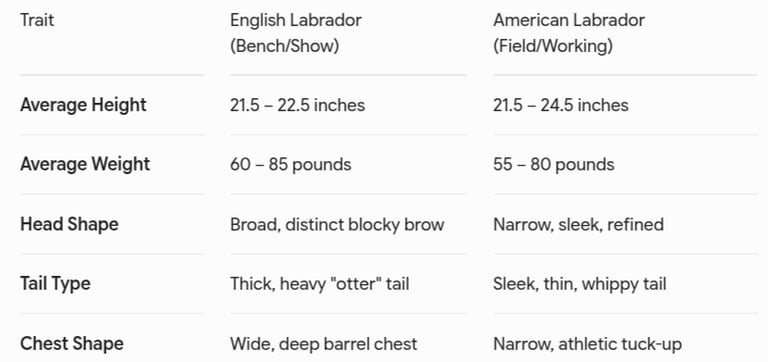
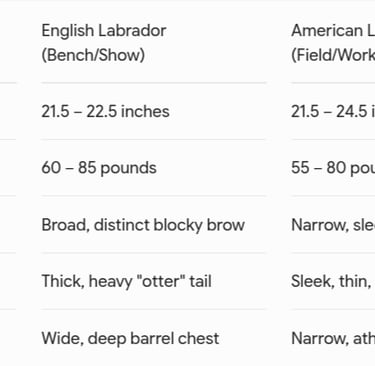
A physical comparison shows English Labradors possess a heavy, barrel-chested frame averaging 21.5 to 22.5 inches in height, while American Labradors stand taller at 21.5 to 24.5 inches with an athletic, leggy build tailored for endurance.
When you look at the two types side by side, the architectural variations in their skeletons are immediately obvious. English lines feature a broad head, a distinct stop (the brow bridge), a shorter muzzle, and a deep chest that sits lower to the ground. American lines exhibit a narrower face, a longer muzzle, and a leaner profile with a noticeable "tuck-up" in the flank.
Which Labrador Type Has the Better Temperament for Families?
Temperament data reveals English Labradors are naturally more laid-back, gentle, and prone to lounging, whereas American Labradors display a high-drive, easily excited personality that requires consistent mental and physical exercise to prevent destructive behaviors.
If your household prefers a relaxed lifestyle, an English Lab settles into the family routine with minimal disruption. They are highly patient and possess a natural "off-switch" that makes them content to snooze on the living room floor.
American Labs bring immense affection but also an unyielding desire to work and sprint. Without a daily outlet like intensive fetching, tracking, or agility, their brilliant minds can easily turn toward counter-surfing, chewing, or digging out of boredom.
What Are the Training Requirements for Each Type?
Training comparisons indicate English Labradors respond beautifully to gentle, low-pressure guidance due to their mellow demeanor, while American Labradors require advanced, highly structured focus training to effectively channel their intense prey drive.
Because of their immense energy, field-bred American dogs need consistent boundaries from day one. They possess an incredible work ethic, but their eagerness can transform into hyper-focus on birds, squirrels, or scents during outdoor activities.
English Labs are equally intelligent but sometimes show a stubborn, slower-paced streak during repetitive drills. They excel with positive reinforcement and short, engaging sessions rather than grueling, high-repetition field routines.
My Perspective:
In my experience living with and raising Labradors, the division between these two lines comes down to managing "drive" and everyday energy. What I found when testing different training routines is that their metabolisms and mental focus operate on completely separate levels.
The English Lab is the quintessential companion if you want a classic, blocky-headed dog that will happily sploot on the tile floor after a casual walk. However, you have to be incredibly strict with their portions; their slower metabolism and relaxed nature make them highly prone to rapid weight gain.
On the flip side, the American field Lab is a true athlete. If you do not give an American Lab a clear job to do, they will invent one—and you probably won't like the blueprint they choose for your backyard or furniture. For an active owner who spends hours outdoors hiking or hunting, the athletic endurance of the field line is unmatched, but for a standard suburban household, the English line's natural "off-switch" is usually the safer bet.


Frequently Asked Questions:
Do English and American Labs belong to the same breed?
Yes. Both are recognized under the single breed standard of the Labrador Retriever by major kennel clubs like the AKC. The terms "English" and "American" are informal labels used by breeders and owners to distinguish between show (bench) lines and working (field) lines.
Can an English Labrador still be used for hunting?
Absolutely. While they have less built-in stamina than field-bred lines, English Labradors still possess strong natural retrieving instincts, a love for water, and excellent scent capabilities. They are perfectly adequate for casual weekend hunting trips.
Which type sheds more?
Both variations possess the signature Labrador double coat and shed heavily year-round, "blowing" their coats twice a year. However, the English Labrador often carries a noticeably denser, plusher undercoat, which can mean a higher volume of loose hair during grooming sessions.
Are there health differences between the two lines?
Both lines are prone to hip and elbow dysplasia, as well as progressive retinal atrophy (PRA). However, because American Labs are bred heavily for field performance, they are slightly more prone to Exercise-Induced Collapse (EIC), while the heavier English lines face a higher risk of obesity-related joint strain.
Labrador Buddy
Get tips, advice, and other information on Labradors
Join Labrador Buddy For Updates
© 2026. All rights reserved.